The rubber tapper who calls himself a rich man
Uncle Yukin never went to school, but has a lifetime of skills we’ve lost
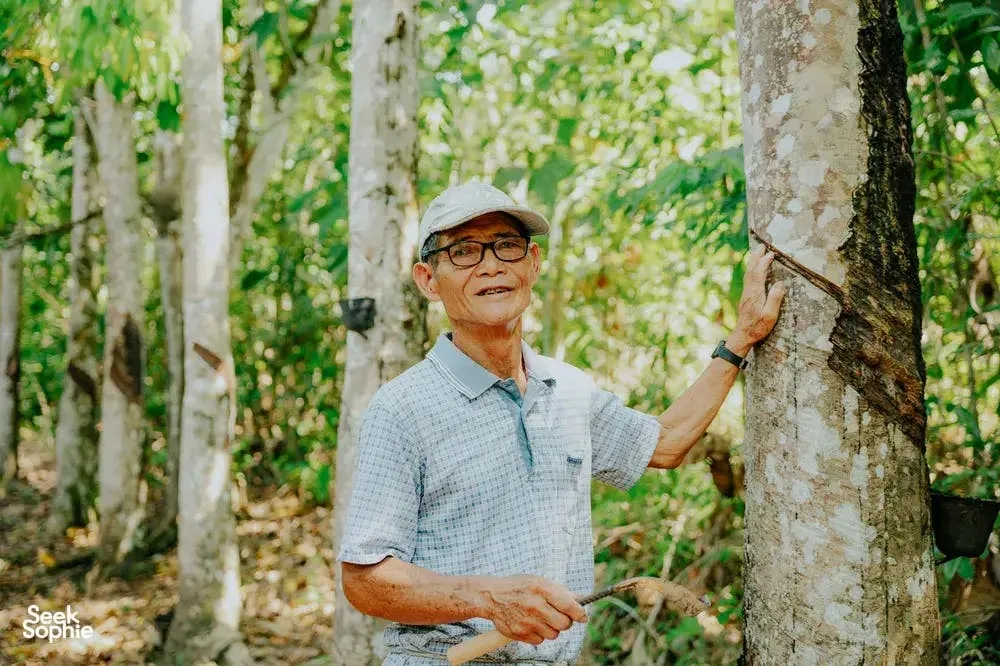
Uncle Yukin never went to school, but he can read a rubber tree.
He knows exactly where to place the knife, how deeply he can cut without hurting the tree and how to make the latex flow. He can make traditional fishing nets and rattan baskets, work the land and, when he was younger, even make some of the tools he needed himself. Today, he looks after around 500 rubber trees in Kiulu, Sabah, using skills he first learnt as a child by following his father around and watching what he did.
For most of his life, Uncle Yukin never thought any of this was particularly unusual. It was simply what he knew how to do.
It was only much later, when travellers started coming to his village and asking him to teach them, that he began to see it differently.
I feel proud to show them that we are also rich here. Just rich in a different way.
His father was his school

Because Uncle Yukin didn't have the opportunity to go to school, his father became his teacher.
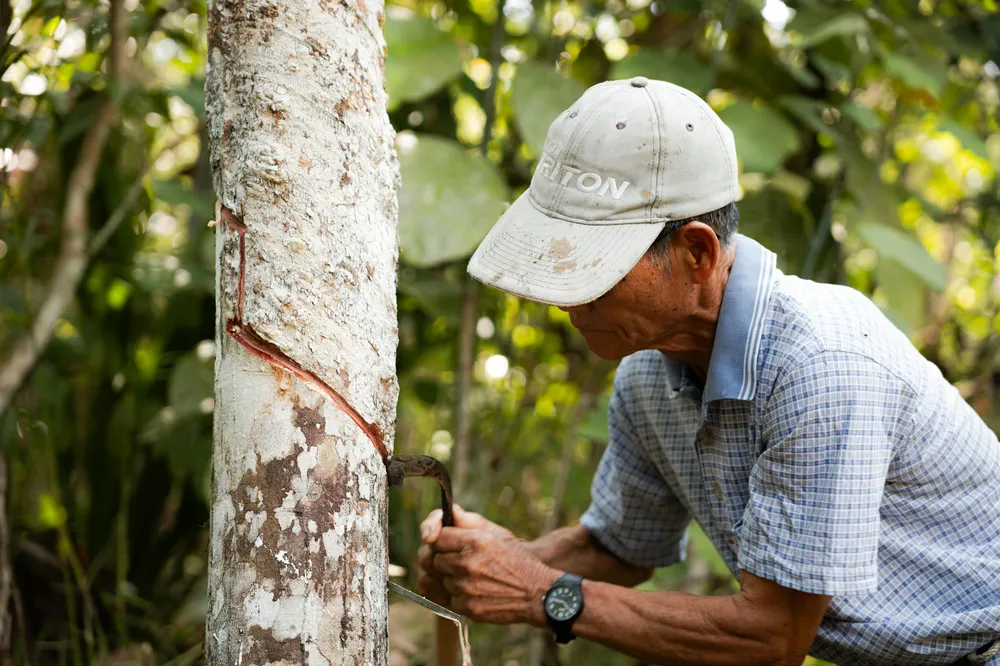
As a child, he would follow him into the rubber plantation and watch how he worked: where he placed the knife, how thin he made the tapping line, how he knew when he had cut deeply enough. Nobody really sat him down and explained it step by step. He watched until he understood enough to try it himself.
That was how most things were learnt at home. Uncle Yukin and his siblings learnt to make rambat, traditional fishing nets, as well as wakid and rattan baskets in much the same way, and when he was younger he also made tools like parang, rubber-tapping knives and gagamas for clearing grass.
This was how knowledge was passed to us, not from books, but by following, watching and doing.
But watching his father tap rubber and actually doing it himself were very different things.
When Uncle Yukin first picked up the knife, he kept cutting too deeply and damaging the trees. What looked like one simple line in the bark actually depended on getting the depth exactly right: too shallow and the latex wouldn't flow properly, too deep and you hurt the tree.
So he kept trying.
Slowly his lines became cleaner and shallower, until one day he finally managed to make a tapping line like his father's - straight, controlled and just deep enough. He still remembers how happy he was.
For someone else it may look like only a small cut on a tree, but when you are learning, being able to do it properly by yourself feels like an achievement.
The work starts years before the latex comes out
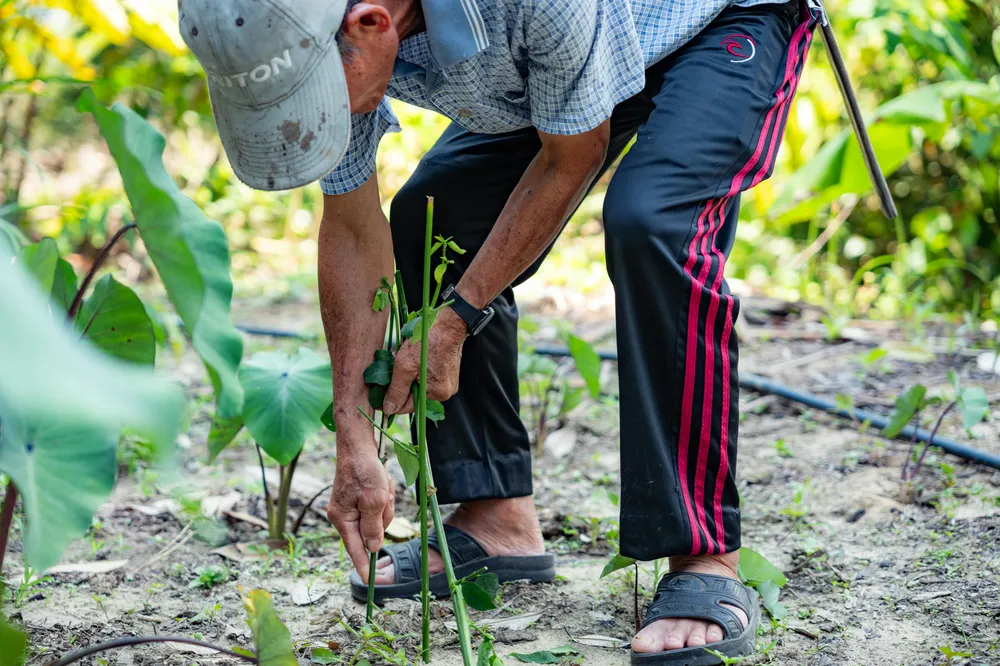
Before a rubber tree can be tapped, the land first has to be cleared and prepared, and on sloping ground that can mean cutting terraces by hand. Then the trees need to be planted, fertilised, weeded and protected from pests for years before they're mature enough to produce anything.
Even after you've done all of that properly, there are still two things Uncle Yukin can't control: the weather and the price somebody decides his rubber is worth.
Rain can ruin a day of tapping because the latex doesn't flow properly along the cut, while long dry spells can cause it to dry before there's anything useful to collect. But some of the hardest years had nothing to do with the trees at all.
When Uncle Yukin's children were still young, he remembers rubber sheets falling to around 60 sen a kilogram.
Imagine collecting and stacking so many sheets, doing all that work, and then seeing how little money you received when you sold them. That was really sad.
Then there were years when the complete opposite happened. Rubber prices climbed so high that people in the village would head down to their plantations at midnight to start tapping before dawn and produce as much as they could. The sheets became valuable enough that some were even stolen from people's homes.
The trees hadn't changed, and neither had the skill or labour required to work them. But what all that work was worth could change completely from one year to another.
For decades, that was how Uncle Yukin's work was valued: by the price of rubber.
Then travellers started coming to Kiulu, and for the first time people seemed just as interested in the knowledge behind the rubber as the rubber itself.
Then strangers started asking him to teach them
When you've done something almost every day of your life, it's hard to imagine anyone travelling across the world to watch you do it.
But that's now exactly what happens. Uncle Yukin takes travellers into his plantation and shows them where to put the knife, how to angle it and how to make the tapping line without cutting too deeply. Then he lets them try for themselves.
He doesn't speak much English, but it turns out you don't really need very much language for this. You watch him, copy what he does, realise it's much harder than he made it look, and try again.
In a way, he's teaching people exactly as his father taught him.
When you have done something your whole life, sometimes you think it is ordinary. Then someone from another place comes and is genuinely interested in learning how you do it. That can make you look at your own life differently.
When our team visited Kiulu, this was one of the moments they kept talking about afterwards. The whole village day became an unexpected favourite because it didn't feel like people were putting on a cultural performance for travellers; the local mothers had cooked and brought food from their own homes, people invited everyone to join in, and Uncle Yukin simply took us into the plantation to show us something he had been doing most of his life.
What was ordinary to him felt extraordinary to us.
And somewhere along the way, that made Uncle Yukin reconsider what he had too.
A different kind of rich
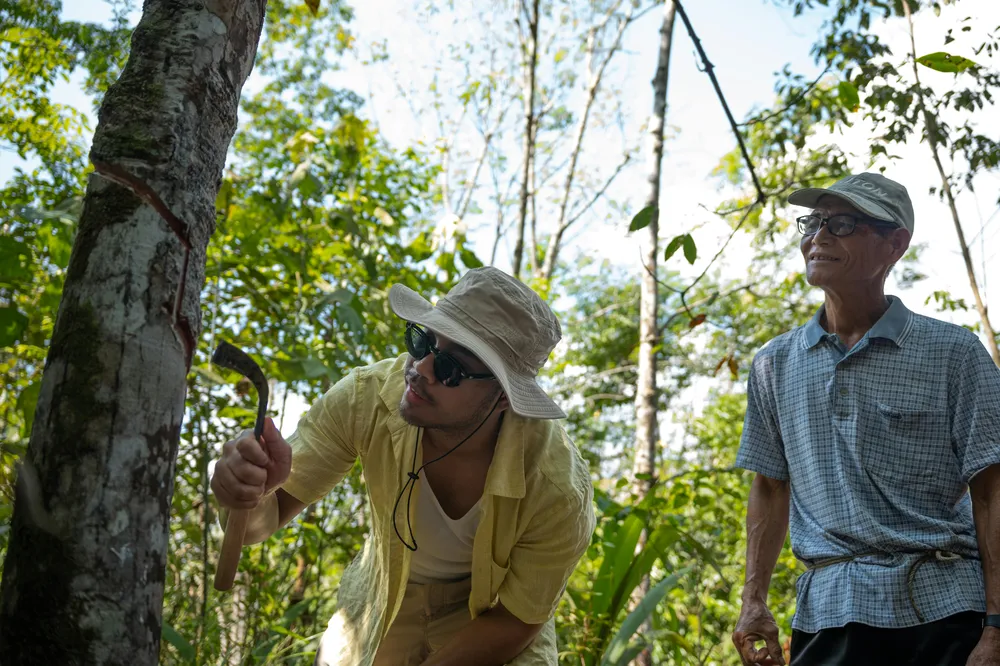
There's an old saying he likes: berbudi kepada tanah. If you take care of the land, the land takes care of you in return.
It's very close to how he thinks about being rich.
I don't mean rich because we have a lot of money. I mean rich because we have land, knowledge, skills and the ability to do many things for ourselves. That is another kind of wealth.
The more time you spend with him, the more sense that makes.
Most of us are taught to measure education through schools and qualifications, and wealth through how much money someone has. Uncle Yukin has neither in the conventional sense, but he has spent a lifetime learning how to make things, grow things and earn a living from the land around him.
The question now is whether anyone will want to learn those things from him.
His hopes for the future
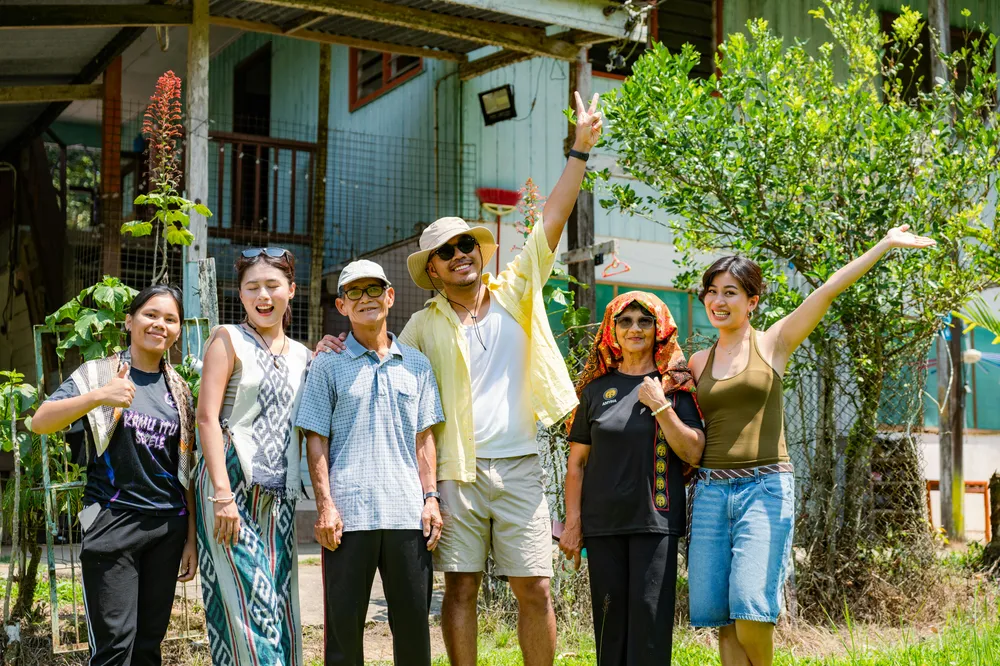
Uncle Yukin understands why younger people in Kiulu might choose different lives. Some will study, some will move to towns and cities for work, and he doesn't expect everyone to become a rubber tapper simply because their parents were.
What he hopes is that the land will still be there for them, and that at least some young people will want to learn these skills while there are still people around who know how to teach them.
I hope there will still be young people who want to learn from us while we are still here to teach them. For me, continuing rubber tapping is not only about earning money. It is also about keeping knowledge alive, looking after the land, and remembering where we came from.
Because a rubber tree can always be planted again. The harder thing to replace is the lifetime of knowledge that tells you how to look after it, when to tap it, how deeply to cut and what to do when things go wrong - especially when much of that knowledge was never written down in the first place.
Uncle Yukin says that the next time you see a rubber tyre, he hopes you think about the person and work that came before it.
After meeting him, you probably will.
Spend a day with Uncle Yukin in Kiulu
If you want to see a side of Sabah that most travellers miss, we'd really recommend this Seek Sophie experience with Uncle Yukin and the families of Kiulu.
Kiulu was one of the unexpected faves from our Sabah trip because it's less about being shown a list of “cultural activities” and much more about spending time with the people who live here. You'll learn rubber tapping from Uncle Yukin, eat food prepared by the local aunties, spend time with villagers and get a much deeper look at everyday Dusun life.
We also love that tourism income from this Seek Sophie experience spreads through the community, supporting the local guides, cooks, farmers and families involved in hosting travellers. Just as importantly, travellers coming here give people like Uncle Yukin another reason to keep sharing knowledge that might otherwise quietly disappear.
You come thinking you're going to learn how rubber is made.
You leave wondering whether Uncle Yukin might actually be richer than most of us.
![Your Cheat Sheet to Planning a Mount Kinabalu Climb [2026]](https://d18sx48tl6nre5.cloudfront.net/webp_xl_4f7a99703162889f64480dfe3c00a2a5.webp)

![Your Cheat Sheet to Planning a Mount Kinabalu Climb [2026]](https://d18sx48tl6nre5.cloudfront.net/webp_md_cd85bdc9ac441cc7398c898710573c06.webp)

![Ethical Places to Spot Orangutans in Southeast Asia [2026]](https://d18sx48tl6nre5.cloudfront.net/webp_md_26a1e349373ffec8569b965090d516ed.webp)
![Ethical Places to Spot Orangutans in Southeast Asia [2026]](https://d18sx48tl6nre5.cloudfront.net/webp_xl_2e78af4a2c06449cbda3a3d258d4dac1.webp)